A post by Pekka A. Viljakainen
 In all honesty, I must admit that my personal carbon footprint has thus far outstripped my size 47 shoes. I’ve heated square footage I didn’t really need to heat and burned my share of kerosene. To quote my daughter, I’ve been “a problem for the planet’s future”. It’s not like I didn’t care. It’s just that I hadn’t come across thought out solutions that allowed me to do something concrete to correct my behavior. Sure, I heat my house with geothermal energy now and I plan to convert all my vehicles to use electric motors, but that’s not enough. My goal is to eliminate my carbon footprint altogether.
I work with world-class scientists, engineers and startups, so I see new concepts every day. This year’s Slush was, once again, a source of endless wonder and seeing what kind of leaps we are about to take was exciting. And the speed is picking up.
It was through technology that I got excited about renewable energy, too. Many research projects and startups are working on issues related to the generation, storage, management and lifespan of energy.
As the son of a small farmer I’m fascinated by the idea of generating the energy I need – like I grow potatoes or how bees collect the honey they’ve made in the summer. It seemed like a great idea, but after the initial rush of excitement I realized there were more solar energy skeptics in Finland than real integrators or people interested in offering solutions.
Since I am the ”Bulldozer”, I decided it’s up to me to act and we started a minor research venture for testing the best available technologies in practice – in Joroinen, of course. It was our aim to find partners and operational models that would allow us to maximize the efficiency and comprehensibility of the integration and lifespan of solar energy. We looked closely into battery technologies available in Europe, the USA and Japan.
I’m a business owner, so for me solar energy has to make business sense. After testing it for a year I can state emphatically: Yes, this makes sense! Thanks to Finland’s long summer days and technology calibrated to get the most out of the conditions of the northern hemisphere, we can get as much energy out of the sun as they do in the north of Germany. Panel output has tripled, while the cost of running systems like this has gone down. Solar energy is relatively worry-free. Unlike with wind generators, there are no moving parts. A solar power plant doesn’t hum and rattle – it generates energy silently, with a humble stolidity. All parts of the system can be monitored remotely and a single annual external checkup suffices. We use a purpose-designed drone, which is essentially a robot with a heat camera.
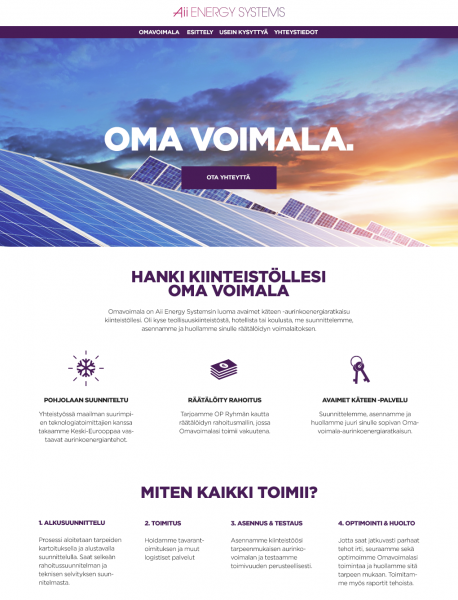
In my eyes solar energy resembles the internet’s early days. All the components were there in the mid-1990s. Anyone could’ve acquired the necessary servers, coders, internet browsers and consultants, but there weren’t many people integrating all that together in a customer-centric manner. That’s just about where we are with solar energy right now. We created the Omavoimala.fi concept as a result of our research project and I decided to personally oversee the commercial rollout. We got the biggest players in the business to join us in this venture and partnered with OP Group to create a new and innovative financing solution. You can finance your power plant using a traditional installment plan or leasing model.
Solar energy is not capable of producing all the energy Finland needs. We need other sustainable solutions, like hydroelectricity, nuclear power, biofuels and wind power. Solar energy has, in my opinion, reached an adequate technological and production level. Now every factory, hotel, public building, apartment building and office can produce a substantial share of the energy they need. And soon we’ll be driving cars that we generate power for ourselves.
Omavoimala is not utopia. It’s reality and born as a result of cold, hard deliberation.